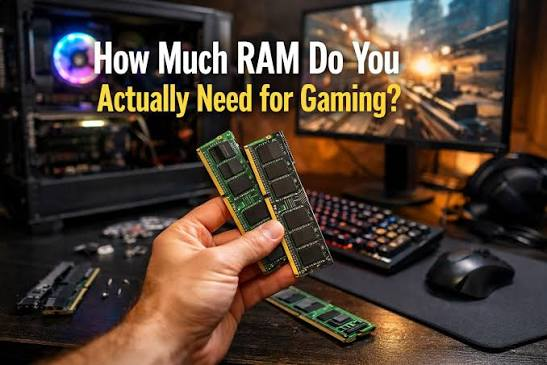

Open the task manager in the middle of a situs slot gacor session and you may be surprised. The game takes a big slice of your memory, the browser takes another, and a chat app quietly eats a third. When the total runs out, everything gets slow in a way that has nothing to do with your graphics hardware. Choosing the right amount of RAM for gaming is one of the cheapest ways to keep a computer feeling healthy, yet people still argue about it endlessly. This guide explains what memory does, how much is enough and how to avoid wasting money on numbers that don’t help.
What memory does
RAM is your computer’s short-term workspace. When you launch a game, the parts it needs right now are loaded into memory, where your processor can reach them quickly. Storage holds everything long term, but memory holds what’s in use.
If there isn’t enough room, the system starts shuffling data back and forth to storage. That’s far slower, and the symptoms are stutter, long pauses and sudden slowdowns.
Why capacity matters
That is why RAM for gaming matters. Modern games load big worlds, detailed textures and complicated systems. They also share space with everything else you have open. A system with too little memory will struggle even if its graphics hardware is excellent.
Having extra doesn’t make games faster by itself. It simply prevents the slowdowns that come from running out. Once you have enough, adding more gives little benefit for gaming.
Rough guidance
Needs change over time, so treat these as broad ideas rather than rules.
- Light and older games run happily on modest amounts of memory
- Most current games are comfortable with a mid-sized amount
- Demanding titles, heavy multitasking and streaming benefit from more
- Very large amounts are only useful for video editing and similar work
Check the recommended specifications of the games you actually play. They’ll tell you more than any general rule.
Speed and dual channel
Capacity isn’t the only factor. Memory also has a speed, and it matters most on certain systems. Faster memory can improve performance in some games, particularly those limited by the processor.
Another factor is how the modules are installed. Using two modules instead of one usually allows dual channel operation, which increases bandwidth. A pair of smaller sticks can outperform a single larger one, so it’s worth buying in pairs.
Checking your usage
Before you buy anything, look at what your system is doing. Open the system monitor while you play and watch how much memory is in use. If it sits well below your total, you’re fine. If it regularly hits the limit, an upgrade may help.
Close unnecessary programs too. Browsers with dozens of tabs can use a surprising amount of memory, and closing a few can improve performance for free.
Overlays, launchers and recording tools use memory as well. If you stream or record while you play, check how much those programs add, and decide whether a larger amount makes sense. Many players find that a modest upgrade solves their problems more neatly than any tweak to graphics settings, because the slowdowns simply stop appearing at the worst moments.
Upgrading safely
Memory upgrades are among the easiest to do yourself. Check what type your system uses, how many slots are free and the maximum it supports. Buy modules that match, preferably from the same kit.
- Switch off and unplug the computer.
- Touch a metal surface to discharge static.
- Open the case and find the memory slots.
- Press the new modules firmly until they click.
- Close up and check that the system recognises the new memory.
Laptops can be trickier, since some have memory soldered to the board. Check your model before buying.
Common mistakes
People often mix mismatched modules, which can cause instability. Others buy huge capacities they’ll never use, or forget to turn on the faster memory profile in the system settings. A quick look at the manual or the manufacturer’s website avoids most problems.
Don’t forget the rest of the system
Memory is only one part of the picture. If your games stutter because of an old processor or slow storage, extra memory won’t cure it. Use performance tools to find the real bottleneck before spending money.
A useful rule is to upgrade only when you can name the problem it solves. Stutter in loading areas, long pauses when switching programs and warnings about low memory are good reasons. A vague feeling that more must be better is not.
Frequently asked questions
Is more RAM for gaming always better?
No. Beyond what your slot88 and background programs need, extra memory brings little benefit.
Does faster memory improve frame rate?
Sometimes, especially in processor-limited games. The effect varies, so don’t expect miracles.
Can I mix different memory modules?
It’s possible, but not ideal. Matching modules from one kit are the safest choice.
The short version
For most players, the right RAM for gaming means enough to cover your games and background programs. Install it in pairs and check usage before upgrading. More isn’t always better, but running out is always worse.